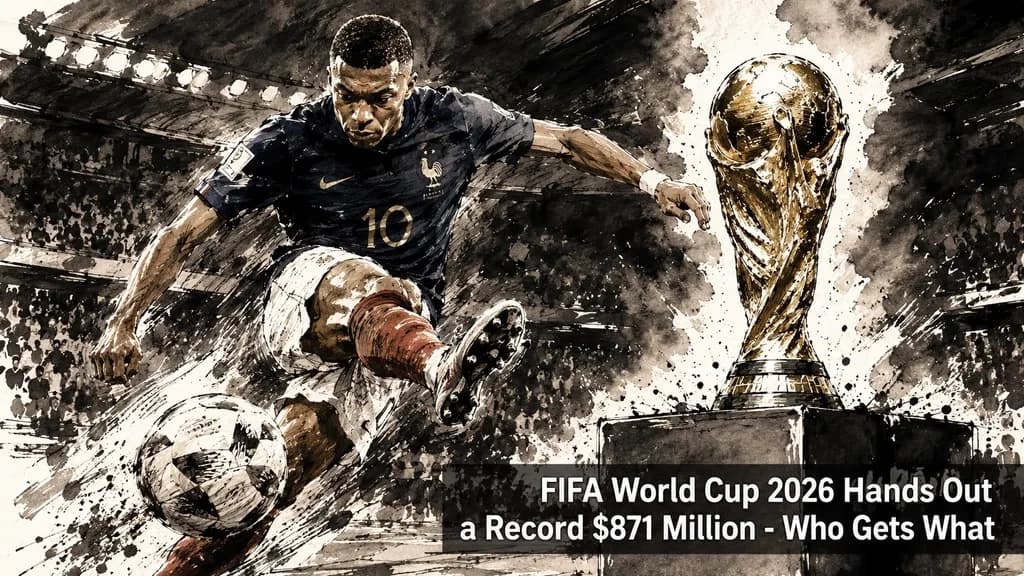
Every four years, one number quietly grows faster than almost anything else in football: the prize check. This year it grew faster than usual. FIFA is distributing $871 million to the 48 teams at the 2026 World Cup, and even the team that gets knocked out in the group stage walks home with more money than most national federations used to earn for winning the whole tournament a generation ago.
That number didn't arrive by accident. It's the product of a bigger tournament, a bigger broadcast deal, and - according to FIFA itself - a deliberate decision to push more revenue back down to the teams that generate it. Whether that's generous or overdue depends on who you ask, but the math is worth understanding, because it explains a lot about where football's money actually flows.
From $528 Million to $871 Million in Two Cycles
The jump is genuinely historic. FIFA paid out $440 million total at the 2022 World Cup in Qatar. For 2026, that figure has grown to $871 million - roughly double, even though reports on the exact 2022 baseline vary slightly between $440 million and $528 million depending on how preparation payments are counted. Either way, it's the largest prize pool increase between two consecutive tournaments in World Cup history.

Part of the jump is structural. The 2026 tournament expanded from 32 teams to 48, adding 40 extra matches, more broadcast inventory, and more sponsorship real estate to sell. FIFA has pointed to higher commercial revenues, the addition of 16 teams, and a deliberate decision to reinvest more of that revenue back into the sport as the drivers behind the increase. FIFA President Gianni Infantino framed it as a philosophy shift rather than a one-off bonus, describing the tournament's financial contribution to the football community as groundbreaking in scale.
The increase also came in two stages. FIFA's council initially approved a $727 million package - $655 million in performance-based prize money plus $72 million in preparation grants - before revising the number upward again in April 2026. That second increase pushed the total to $871 million, adding more than $100 million on top of the original plan, much of it earmarked for teams' travel and lodging costs across a tournament spread over three countries.
How the Payout Ladder Actually Works
Money in football almost never depends on effort alone - it depends on where you finish. The World Cup's prize structure is built entirely on that logic, in two layers.

Layer one: money every team gets, win or lose. Simply qualifying is worth something. Every one of the 48 teams receives a guaranteed floor before a ball is kicked, made up of a $10 million qualification fee plus $2.5 million in preparation funding - a guaranteed minimum of at least $12.5 million per team, regardless of results.
Layer two: performance money that scales with every round survived. This is where the gap widens fast. Based on FIFA's distribution figures, the ladder looks like this:
- Group stage exit (33rd-48th place): $9 million
- Round of 32: $11-12 million
- Round of 16: $15-16 million
- Quarterfinalists: $19-20 million
- Fourth place: $27 million
- Third place: $29 million
- Runner-up: $33 million
- Champion: $50 million
Stack the two layers together and the number gets serious. The champion's total payout, once qualification and preparation funding is added to the performance prize, exceeds $63.5 million - and that's before any bonus their own federation chooses to add on top. For comparison, Argentina earned $42 million for winning in 2022. This year's champion earns roughly $8 million more than that in performance money alone, which is, incidentally, the biggest jump in the champion's prize between any two tournaments on record.
It's worth pausing on what that middle tier means in practice, because it's easy to only notice the number at the very top. A team eliminated in the round of 16 - not a bad run by most standards - still collects somewhere around $28-29 million once the guaranteed floor is added in. That's not pocket change for a federation that might normally run on a fraction of that budget for years. The economics of "just" reaching the knockout stage have quietly become transformative for smaller footballing nations.

Why FIFA Found Another $100 Million in April
The mid-tournament-cycle increase wasn't purely generosity. Several European federations reportedly lobbied FIFA for additional support to cover the unusually high logistics costs of a World Cup split across the United States, Canada, and Mexico - three countries, sixteen host cities, and, for some squads, thousands of miles of travel between group-stage venues alone. FIFA's response was to add more than $100 million to the pool specifically to offset those costs, on top of the base prize structure it had already announced.
There's a broader financial story sitting underneath that decision. FIFA has repeatedly said the organization is in the strongest financial position in its history, driven by the 48-team format's expanded broadcast and sponsorship footprint. Reinvesting a slice of that windfall into participant payouts is, in FIFA's own framing, a business decision as much as a goodwill gesture - happier federations mean fewer disputes over the increasingly demanding tournament calendar.
What This Actually Means for the Players

Here's where it gets less straightforward. The prize money FIFA distributes goes to national federations, not directly to players. What a player actually takes home depends entirely on the bonus structure their own football association negotiates - and those vary enormously. Some federations split a large majority of the prize pool with the squad; others keep the bulk for youth development, infrastructure, or federation operating costs, with players receiving a much smaller negotiated share.
That's a genuinely debated point in football economics. Player unions and some commentators argue that federations, especially in wealthier countries, could pass along a larger share to the athletes who are the reason the tournament generates broadcast revenue in the first place. Others counter that national federations exist to fund the sport at every level - youth academies, women's programs, grassroots facilities - not just to reward the senior men's team, and that treating prize money as pure player compensation misunderstands what a federation is for. Both positions have legitimate footing, and the split looks different in almost every one of the 48 countries involved.
There's also an unavoidable comparison that keeps surfacing: the men's World Cup prize pool now dwarfs the Women's World Cup pool many times over, even as FIFA has increased both in recent cycles. That gap has become its own recurring point of pressure on FIFA from players, unions, and some national federations, and it's likely to shape how the next disribution cycle is negotiated.
The Bigger Picture

What the 2026 numbers really show is how much the economics of international football have shifted in a single generation. Italy's 1982 World Cup winners took home $2.2 million combined. This year's champion's federation alone clears more than $63 million before a single sponsorship bonus is added. That's not inflation - that's an entirely different sport, financially speaking, wrapped around the same 90 minutes of football.
For fans, the headline number is mostly trivia. For federations - especially the smaller ones for whom $12.5 million might represent years of budget - it's the difference between scraping by and actually investing in the next generation of players. That's arguably the most consequential part of this story, even if it's the least discussed one.
Key takeaway: The real story of World Cup prize money isn't the $50 million trophy check - it's the $12.5 million guaranteed floor that every qualifying nation now receives, win or lose.
References & Resources:
- FIFA, "FIFA Council approves record-breaking FIFA World Cup 2026 financial contribution" - inside.fifa.com
- CNBC, "Here's what to know about the World Cup prize money" - cnbc.com
- Sports Illustrated, "2026 FIFA World Cup Prize Money: Full Payout Breakdown for Every Team" - si.com
- Sports Illustrated, "2026 World Cup Prize Money: How Much Each Team Will Earn" - si.com
- Open The Magazine, "FIFA World Cup 2026 Prize Money: Record $871 Million Pool and Full Breakdown" - openthemagazine.com
- Fortune, "World Cup teams will be paid a record $871 million" - fortune.com
- Yahoo Sports, "How much does World Cup winner get? Explaining record-breaking prize money for 2026" - sports.yahoo.com