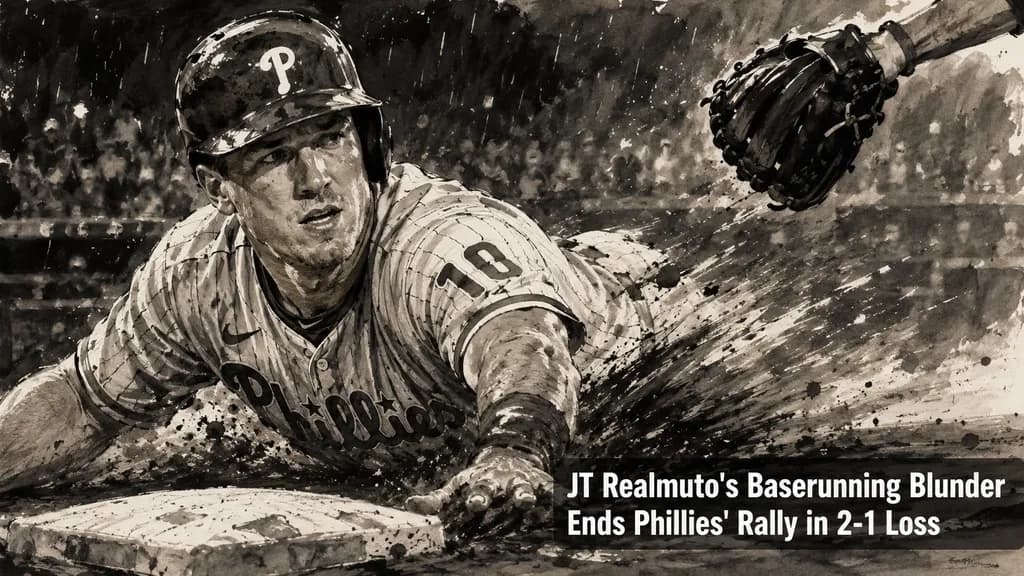
Two outs on one play. That is not supposed to be possible in baseball, and yet it happened to the Philadelphia Phillies on Tuesday night at Citizens Bank Park, in the most excruciating way a nine-run comeback chance can die.
Trailing the Los Angeles Dodgers 2-1 in the bottom of the ninth, Philadelphia had runners on second and third with one out and Brandon Marsh at the plate. A routine-looking rundown turned into a game-ending double play, and the player at the center of it wasn't the rookie who got caught in no-man's land. It was veteran catcher J.T. Realmuto, a three-time All-Star who, by his own admission, simply lost track of the situation.
How the Rally Fell Apart
The sequence started well for Philadelphia. Realmuto had just doubled to left field, moving the tying run to third base and the winning run to second with one out. Brandon Marsh, an All-Star this season, stepped in with a real chance to end the game with a base hit, a sacrifice fly, or even a wild pitch.

Marsh hit a hard ground ball, but directly at Dodgers third baseman Max Muncy. Pinch runner Justin Crawford, who had been instructed to run on contact, broke for home and got caught in a rundown between third base and the plate. Phillies interim manager Don Mattingly later confirmed Crawford was running on contact no matter where the ball went, so his predicament was, in a sense, a designed risk that simply didn't pay off this time.
That part of the play was defensible. What happened next was not.
While Crawford was tangled up in the rundown, Realmuto advanced safely to third base — exactly where he needed to be. The ideal play from there was simple: stay put at third while Crawford kept the Dodgers occupied in the rundown long enough for Marsh to reach second, turning second-and-third-with-one-out into second-and-third-with-two-outs. Instead, for reasons even Realmuto couldn't fully explain afterward, he turned around and sprinted back toward second base.
Dodgers shortstop Mookie Betts tagged Crawford out near third, then spun and fired to second baseman Tommy Edman, who caught Realmuto sliding back into the bag. Game over. Final score: Dodgers 2, Phillies 1.

A Veteran's Rare Lapse in Judgment
Realmuto didn't dodge the postgame questions. He called it "just a lack of judgment," telling reporters he had no business leaving third base once Crawford was already tied up in the rundown.
Mattingly was equally blunt about his confusion in the dugout, admitting flatly that he wasn't sure what his catcher had been thinking in that moment. The manager's honest bewilderment said as much about the play as any stat line could.
Even Phillies broadcaster John Kruk reportedly sat in stunned silense watching the replay, unable to process why a tenured catcher with a decade of postseason experience would abandon the safest base on the field in the middle of a rundown. To be fair to the Dodgers, this wasn't purely a Phillies gift. Betts had to make an off-balance, awkward throw across the diamond, and Edman still needed to apply a clean, bang-bang tag. It was a genuinely difficult double play to execute — the Dodgers just happened to be handed the opportunity to try it.

The Numbers Behind a Tough Season
The blunder lands during a rough offensive stretch for Realmuto. He's hitting .215 with seven home runs this season, well below his career batting average of .268, a gap that has fueled ongoing conversation in Philadelphia about his production behind the plate as he enters his mid-thirties. The loss also dropped the Phillies to 56-46 on the season, a game behind a Dodgers club sitting at 64-38, in what has become one of the National League's most closely contested rivalries — a rivalry with real postseason scar tissue, since Los Angeles eliminated Philadelphia in last year's playoffs by a combined margin of just four runs across three games.
On the pitching side, the defeat obscured what was otherwise a strong outing from Zack Wheeler, who allowed just one run — a two-run homer from Max Muncy in the fourth inning was technically the only Dodgers scoring, an early sign of how tightly the two aces were dueling. Wheeler took the tough-luck loss despite striking out nine batters over seven innings, while Dodgers starter Justin Wrobleski earned the win after allowing only one run in six-and-a-third innings of his own.
What Baserunning Blunders Actually Teach Us

It's tempting to write this off as one bizarre highlight-reel moment, but the play is a useful case study in decision-making under pressure — on a baseball field or anywhere else.
- Default to the safest known outcome. Realmuto was already standing on the safest base available to him. The instinct to "do something" in a chaotic moment, rather than simply hold a secure position, is a documented pattern in high-pressure decision-making research, not just a baseball problem.
- Pre-play visualization matters. Realmuto himself pointed to this afterward, saying he should have mentally rehearsed the rundown scenario before it occurred rather than reacting to it in real time. Athletes and professionals alike perform better when they've already walked through likely branching scenarios in advance.
- One mistake shouldn't erase the value of the play before it. Realmuto's double is what created the scoring chance in the first place. It's worth remembering that a single lapse, however costly, doesn't cancel out the skill that got the team into position to win.
A Costly Lesson, Not a Career-Defining One
Philadelphia will get another shot to prove the loss was an aberration rather than a trend, with the New York Yankees coming to Citizens Bank Park this weekend before a road trip to Miami. Realmuto, for his part, owned the mistake without excuses — a rare enough thing in professional sports that it's worth noting on its own.
Key takeaway: In a rundown, the runner who is already safe should almost never volunteer to become unsafe again.

References & Resources:
- Fox News, "J.T. Realmuto's baserunning blunder ends Phillies loss to Dodgers" - https://www.foxnews.com/sports/phillies-star-jt-realmuto-makes-inexplicable-baserunning-blunder-end-game-leaves-manager-dumbfounded
- CBS Sports, "J.T. Realmuto concedes 'lack of judgment' in sloppy double play blunder in Phillies' loss to Dodgers" - https://www.cbssports.com/mlb/news/phillies-dodgers-double-play-jt-realmuto-justin-crawford/
- The Score, "Phillies' Realmuto laments 'bad' game-ending baserunning blunder" - https://www.thescore.com/mlb/news/3569267/phillies-realmuto-laments-bad-game-ending-baserunning-blunder
- The Philadelphia Inquirer, "Phillies' costly baserunning blunder highlights a rain-delayed 2-1 loss to the Dodgers" - https://www.inquirer.com/phillies/phillies-dodgers-score-zack-wheeler-justin-wrobleski-jt-realmuto-20260721.html
- Down Beach News, "Devil in the details: Phillies baserunning blunder costs them against Dodgers" - https://downbeach.com/sports/philadelphia-phillies-news-los-angeles-dodgers-jt-realmuto-justin-crawford-don-mattingly-brandon-marsh-baserunning-blunder-mlb-wild-ending/