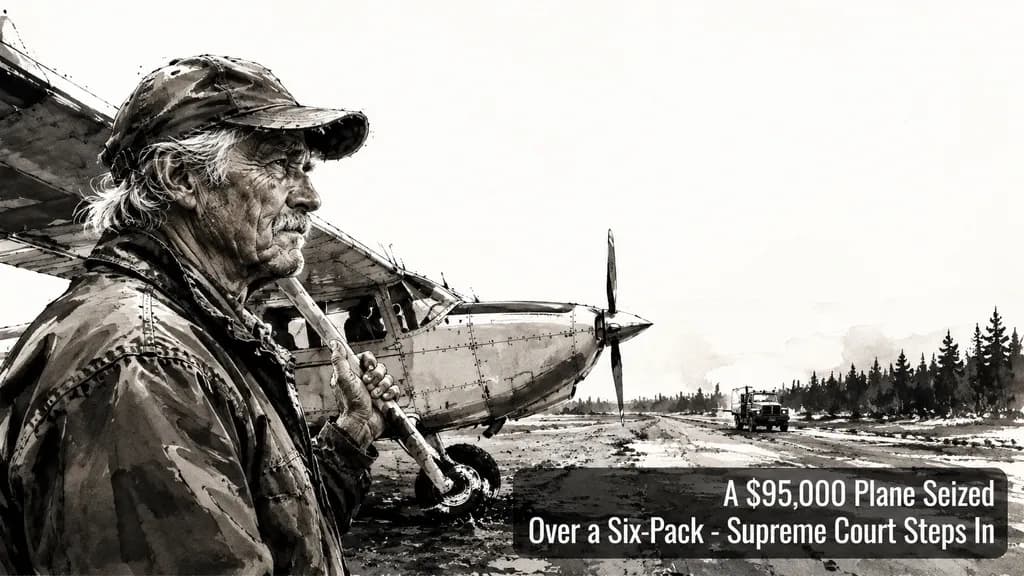
Ken Jouppi has been flying bush planes over Alaska's interior for more than five decades, landing on gravel strips and frozen rivers where no road will ever go. In April 2012, one routine flight from Fairbanks to the village of Beaver ended with state troopers searching his Cessna, finding a six-pack of Budweiser in a passenger's grocery bag, and setting off a legal fight that has now reached the highest court in the country.
Thirteen years later, Jouppi is in his 80s, and the state of Alaska is still trying to take his $95,000 airplane. On July 20, 2026, the U.S. Supreme Court agreed to hear his case, which asks a question that sounds almost absurd on its face: can the government seize an entire aircraft because of one six-pack of beer?
The Flight That Started It All
Beaver, Alaska, is a village of roughly a hundred people, 110 miles north of Fairbanks, reachable mainly by small plane. Like many rural Alaska Native communities, residents voted in 2004 to go "dry," making it a state crime to bring alcohol into the village. That's the law Jouppi's passenger broke when she packed beer among her groceries as a gift for her husband, the local postmaster.
Hidden in the passenger's luggage were three cases of beer, two Budweiser and one Bud Light, meant as a gift to her husband. Troopers searched the plane before takeoff and found the alcohol. Jouppi was ultimately convicted only for a single six-pack of Budweiser that troopers said was in plain sight. A jury convicted him of a misdemeanor for knowingly transporting alcohol into a dry community, and a judge sentenced him to three days in jail.

Jouppi insists he never looked inside his passenger's bags. As his petition to the Supreme Court put it, no law required him to search a passenger's belongings, and doing so would feel invasive and demeaning. The state disagreed, arguing troopers believed the beer was visible enough that Jouppi should have known it was there.
The criminal case, though, was only the beginning. The bigger fight was over the plane itself.
When a Misdemeanor Becomes a $95,000 Penalty
After the conviction, Alaska prosecutors moved to forfeit Jouppi's 1969 Cessna U206D under the state's criminal forfeiture statute, arguing the aircraft had been used to commit the crime. A trial court initially sided with Jouppi, ruling that taking a $95,000 plane over a six-pack would be an unconstitutionally excessive fine. The state appealed, and the fight bounced through Alaska's court system for over a decade.
This past April, the Alaska Supreme Court ruled that the harm of a single six-pack of beer warranted seizing something as valuable as an airplane. The court's reasoning leaned on the broader social costs of alcohol in rural Alaska rather than the specifics of Jouppi's individual conduct. The ruling stated that alcohol abuse in rural Alaska leads to increased crime, disorders such as alcoholism, conditions such as fetal alcohol spectrum disorder, and death, imposing substantial costs on public health and the administration of justice, and concluded that the illegal importation of even a six-pack of beer causes grave societal harm.

Jouppi's attorneys at the Institute for Justice, a libertarian public-interest law firm that has repeatedly challenged forfeiture practices nationwide, argue the state court got the analysis badly wrong. Rather than weighing what Jouppi himself actually did, they say, the Alaska Supreme Court judged the crime "purely in abstract terms," treating a first-time, unwitting misdemeanor the same as the worst-case version of the offense.
Key takeaway: proportionality is the whole ballgame here. The Eighth Amendment doesn't ask whether alcohol abuse is a serious problem in general — it asks whether this penalty fits this person's conduct.
Why the Excessive Fines Clause Matters Now
This case doesn't exist in a vacum. It builds directly on a landmark 2019 ruling most Americans have never heard of but that reshaped how forfeiture works nationwide.
In Timbs v. Indiana, the Supreme Court formally applied the Eighth Amendment's Excessive Fines Clause against the states in a unanimous decision, a first step toward using the Eighth Amendment to combat court fees and fines that disproportionately affect the poor. That case involved Tyson Timbs, whose $42,000 Land Rover was seized after he used it to make a small heroin sale, even though the maximum fine for his offense was far lower. Timbs's total monetary loss from the seizure amounted to more than four times the maximum fee he should have been required to pay under federal law.

Timbs established that the Excessive Fines Clause applies to states. What it never fully settled is how courts should measure "excessive" — and that gap is exactly what Jouppi's case is now asking the justices to close.
Historically, an individual's ability to pay a fine or forfeiture was an essential factor in weighing excessiveness, yet even after acknowledging that history, the Court in Timbs stopped short of setting out a clear test that accounts for a defendant's ability to pay. Lower courts have been left to fill that vacuum in wildly different ways. Some, including Alaska's high court, look mainly at the maximum possible penalty and the general harms a law is meant to prevent. Jouppi's lawyers want the Supreme Court to instead require judges to look closely at the individual's actual conduct — a first-time misdemeanor with no violence, no repeat offense, and beer that belonged to someone else entirely.
As Jouppi's lawyers wrote in their petition, no matter that the offense was a misdemeanor, no matter that the pilot was a first-time offender, no matter that the alcohol was a six-pack of Budweiser, no matter that it belonged to a customer, the result was an airplane forfeited for a six-pack.
What's Actually at Stake for Ordinary People
It's easy to read this as a quirky, isolated Alaska story. It isn't. Civil and criminal forfeiture generate significant revenue for state and local governments across the country, and critics on both the left and right have long argued that this creates a financial incentive for law enforcement to pursue seizures aggressively, sometimes with penalties wildly disproportionate to the underlying offense.

That's part of why Jouppi's case has drawn support from an unusually broad coalition. Groups spanning the Drug Policy Alliance and the NAACP to Americans for Prosperity and FreedomWorks Foundation have filed briefs arguing that civil asset forfeiture disproportionately affects low-income communities and communities of color, and is precisely what the Excessive Fines Clause was meant to guard against. Rural Alaska adds its own layer of nuance: dry-village laws exist because Alaska Native communities have used local option votes to fight genuinely serious alcohol-related harm, and the state's brief leans hard on that public health record.
Both things can be true at once — that alcohol restrictions in dry villages serve a real and serious purpose, and that seizing a working pilot's entire livelihood over a six-pack, without regard to his specific culpability, may still cross a constitutional line. That tension is exactly what the justices will have to sort out.
If you want to actually track this case rather than just read about it once, here's how:
- Bookmark the Supreme Court's docket page for Jouppi v. Alaska and check it after oral arguments this fall — briefs, transcripts, and the eventual opinion are all posted publicly and free to read.
- Read the Timbs v. Indiana opinion first if the legal reasoning feels unfamiliar; it's the foundation this new case is built on, and it's a surprisingly readable ruling for a Supreme Court decision.
- Watch for the "gross disproportionality" test in coverage of the eventual ruling — that phrase, borrowed from the 1998 case United States v. Bajakajian, is the legal hinge the whole case turns on.
The Bigger Picture
Jouppi's case won't be argued until the Supreme Court's next term begins in October, and a ruling likely won't arrive until sometime next summer. Win or lose, it will shape how forfeiture cases are decided far beyond Alaska — from cars seized in minor drug stops to boats confiscated over fishing violations to, apparently, airplanes taken over a six-pack.

There's something almost archetypally American about an octogenarian bush pilot going toe-to-toe with the state over a principle rather than the money itself. Jouppi said he's been fighting this for over a decade because he sees it as his duty to ensure the Bill of Rights actually means something in protecting against government overreach. Whether or not you think dry-village alcohol laws are good policy, that's a case worth watching closely.
Remember: the size of a punishment should match the size of the offense — that idea is older than the country itself, and it's now sitting in front of nine justices, hinging on a six-pack of beer.
References & Resources:
- Institute for Justice, "Jouppi v. Alaska" case overview: ij.org/case/alaska-excessive-fines
- The Hill, "Supreme Court to decide if Alaska can seize pilot's plane over 6-pack of beer": thehill.com
- ClickOrlando/AP, "Alaska wants to seize a pilot's plane over a 6-pack of beer": clickorlando.com
- Reason/Yahoo News, "An Alaska Man's $95,000 Plane Was Seized Over a 6-Pack of Beer": yahoo.com
- Brennan Center for Justice, "Timbs v. Indiana" case summary: brennancenter.org
- Harvard Law Review, "Timbs v. Indiana" case comment: harvardlawreview.org