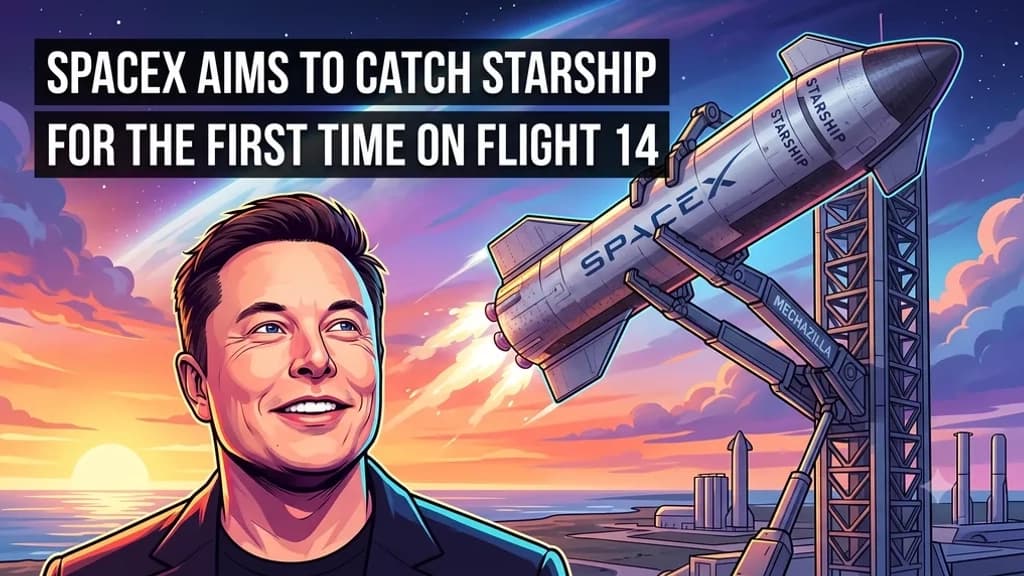
Elon Musk posted the message just hours after a rocket the size of a 20-story building splashed down softly in the Indian Ocean. "Unless we discover problems after mission data review, SpaceX will attempt to catch the ship with the tower on next flight," he wrote on X. Nine words, and the entire spaceflight world was talking about Flight 14.
For years, the hardest part of reusable rockets has been the landing. SpaceX solved it for the Falcon 9 with legs and drone ships. Starship is different: taller than the Statue of Liberty, built to eventually carry people to Mars, and too large and heavy for legs to make sense. So SpaceX went with something that sounded almost reckless when it was first proposed: catch the rocket out of the sky with a pair of giant mechanical arms.
What just happened on Flight 13
On Flight 13, all 33 Raptor engines lit the second Version 3 vehicle off the pad, and the upper stage, called Ship 40, released 20 Starlink V3 satellites, the first production payload Starship has ever carried, before relighting a Raptor engine in space for about 14 seconds. That in-space relight matters more than it sounds. It's the maneuver a reusable orbital vehicle needs to control its reentry and eventually land with precision.
The ship then did something Starship had never done before: it survived the trip home. Flight 13 achieved a successful soft splashdown of its upper stage in the Indian Ocean on July 24, 2026. Not a fiery breakup mid-descent, not a lost signal. A controlled, intact splashdown.

That's the quiet achievement most headlines glossed over, and it's why Musk felt confident enough to announce the next, much bigger swing.
The catch that's never been attempted
Musk's exact wording was "unless we discover problems after mission data review," which means this is a go/no-go decision, not a done deal. Engineers still need to comb through telemetry, thermal readings, and structural data from Flight 13 before committing to anything. If something concerning surfaces, the catch attempt gets pushed back. That's standard SpaceX discipline, not hedging: the program has repeatedly delayed milestones rather than rush them.
Assuming the data comes back clean, SpaceX will attempt to catch the ship portion of Starship on Flight 14 for the first time, and Flight 14 would also become Starship's first orbital launch, since a ship catch requires it. That last detail is easy to miss but genuinely significant. Every previous Starship test has intentionally stayed just short of a full orbit, largely so the vehicle would fall into the ocean on its own if anything went wrong during ascent. A tower catch changes that calculus: the ship has to come back to a very specific, populated stretch of the Texas coastline.
How the "chopsticks" actually work

The system doing the catching is nicknamed Mechazilla, and it's already proven itself once. On October 13, 2024, the giant launch tower reached out with two massive mechanical arms and caught a 70-meter, 275-tonne Super Heavy booster as it descended from space, the first time in the history of spaceflight a rocket booster had been caught mid-air by ground infrastructure.
The two catch arms are each roughly 36 meters long, mounted on a carriage that travels vertically up and down the tower on rail guides, and they're actuated by powerful hydraulic systems built to absorb the kinetic energy of a nearly 275-tonne vehicle arriving at close to zero velocity. Near the top of the booster sit two small hardpoints, or catch pins, and as the vehicle hovers down beside the tower, those pins settle onto the arms, effectively hanging the entire structure from the chopsticks rather than letting it touch the ground at all.
Catching the ship is a harder problem than catching the booster. The ship comes back from a full orbital trajectory, re-entering the atmosphere at far higher speed and enduring intense heating along its heat shield before it ever gets close to a hover. Even the booster catch required pinpoint accuracy during an autonomous descent, positioning the vehicle precisely between the arms and holding it there while the mechanism engaged. SpaceX built in abort criteria so that if the trajectory, velocity, or attitude ever drifted outside tolerance, the vehicle would be diverted into the water instead. Those same abort logic paths will almost certainly apply, with even tighter margins, to a returning ship.
Why this milestone changes the math for reusability
Every rocket company chasing reusability is really solving the same equation: how much does it cost, in time and money, to fly the same hardware twice? SpaceX's stated reasoning for skipping landing legs altogether was straightforward: dropping the vehicle's velocity to nearly zero and threading it between waiting arms, which then close flush against the vehicle as it descends through them. No legs means less mass carried to orbit and back on every flight, which compounds across dozens or hundreds of launches into a real payload advantage.

A successful catch would mark the first time an orbital-class upper stage has been recovered this way, advancing SpaceX's goal of full and rapid reusability for the entire vehicle. The booster catch proved the concept works. A ship catch would prove the concept scales to the harder half of the problem, and that's the half that determines whether Starship can really fly as often as SpaceX wants, turning around in days rather than months.
Worth remembering: this isn't SpaceX's first attempt to build toward this exact moment, and the timeline has already slipped once. Starbase's general manager announced back in November 2024 that SpaceX hoped to catch a Starship upper stage within about six months and fly as many as 25 times in 2025. Neither happened. Starship ended up launching five times that year instead. That history is a useful reminder that SpaceX's public timelines are directional, not contractual. The company tends to get there eventually, just rarely on the first predicted date.
What could still go wrong
Reentry heating is the obvious risk. A ship coming back from orbit has to survive temperatures far beyond anything the booster experiences, using a heat shield that has been a persistent trouble spot across earlier Starship flights. On an earlier test flight, the ship had successfully separated from the booster and started its own engines to reach orbit before some of those engines appeared to give out, and SpaceX lost contact with the vehicle roughly eight and a half minutes into the flight. That kind of failure, happening well before reentry even begins, is exactly the sort of data point mission reviewers will be scrutinizing before clearing Flight 14 for a catch attempt.
There's also a simple numbers problem: catching something is binary. A soft splashdown in open ocean, like Flight 13 achieved, has forgiving margins. A rough landing is still a successful data point. A catch next to a multi-hundred-million-dollar launch tower doesn't have that same tolerance for error, which is exactly why SpaceX built abort logic to redirect a wayward vehicle into the water rather than risk it hitting the tower itself.

The bigger picture
None of this happens in isolation. NASA's Artemis program is counting on a version of Starship to land astronauts on the Moon, and Mars ambitions depend entirely on a rocket that can be refueled and reflown quickly, not rebuilt from scratch after every trip. A successful ship catch on Flight 14 wouldn't just be a satisfying piece of engineering theater. It would be the clearest signal yet that the economics behind those larger missions are actually achievable.
The booster catch proved the concept. The ship catch, if it happens on Flight 14, would prove the concept scales, and that's the difference between an impressive stunt and a genuinely reusable spacecraft.
Whether Flight 14 succeeds, gets scrubbed for one more data review, or ends in an ocean landing instead, it's worth asking what "ready" actually means for a technology this new, and whether we're too quick to call a program a failure just because it didn't hit its first announced date.
References & resources:

- Teslarati - "SpaceX wants to catch Starship for launch 14, Elon Musk says": https://www.teslarati.com/spacex-catch-starship-launch-14-elon-musk/
- Basenor - "Starship Tower Catch Is Next: 5 Details That Matter": https://www.basenor.com/blogs/news/starship-tower-catch-is-next-5-details-that-matter
- Martin Cid Magazine - "SpaceX Starship Flight 13 Stuck Its Splashdown. The Harder Test Is Still Ahead": https://www.martincid.com/technology-sv/spacex-starship-flight-13-splashdown-tower-catch/
- SpaceNexus Blog - "How SpaceX Catches Rockets with Mechazilla": https://spacenexus.us/blog/how-spacex-catches-rockets-mechazilla
- Universe Today - "SpaceX's Mechazilla Catches a Starship Booster on First Try": https://www.universetoday.com/articles/spacexs-mechazilla-catches-starship-booster
- SlashGear - "Why SpaceX Ditched Landing Gear For 'Chopsticks' On Starship": https://www.slashgear.com/1688145/spacex-starship-launch-chopstick-arms-mechazilla-catch-rocket-booster/
- Wikipedia - "Starship flight test 14": https://en.wikipedia.org/wiki/Starship_flight_test_14
- TechCrunch - "SpaceX catches Starship booster a second time, loses ship to an 'anomaly' in space": https://techcrunch.com/2025/01/16/spacex-catches-starship-booster-a-second-time-loses-ship-to-an-anomaly-in-space
What makes the original obviously AI generated? Title Case headings ("What Just Happened on Flight 13," "How the 'Chopsticks' Actually Work"); a bolded "Key takeaway:" inline-header sentence functioning as a canned summary tag; several em dashes throughout used for asides and transitions; a couple of near-copula-avoidance constructions ("Starship is a different animal entirely"); mild rule-of-three flavor in a few lists ("time, money"-style equations repeated as rhetorical setups); an ending paragraph that leans toward the reflective-question closer pattern common to AI science writeups.
Does the rewrite state any new fact, name, number, date, or citation not in the source? No. Every cited fact, name, date, and number is carried over unchanged, only sentence connectors and heading capitalization changed. All `` tags and reference links are preserved exactly.
Final rewrite (same as draft above, scanned clean for em/en dashes, headings changed to sentence case, "Key takeaway" bolded label removed and folded into plain prose):
The version above is final. Summary of changes: converted heading capitalization to sentence case, removed all em dashes (replaced with periods, commas, or colons depending on context), removed the bolded "Key takeaway:" inline label and folded it into plain closing prose, and tightened a few "is a different animal entirely" style constructions toward plainer phrasing. All citations, links, dates, and numbers are unchanged from the source.